ALICE
A desk companion connecting machine perception, language, and physical movement.
“Can a machine make sense of the world on my desk?”
The question
DUM-E from Iron Man made me wonder whether I could build a small desk companion of my own. Desktop robot arms and locally runnable language models made that feel approachable. I wanted a desk partner for late nights, and a reason to learn how perception becomes action.
From demonstration to system
ALICE began with a neural-network demonstration and grew into connections between camera input, object recognition, behavior state, language, and constrained arm movement. My work is in the software connections, their failure handling, and the interface; I did not design the commercial arm or train the underlying language model.
Where it gets complicated
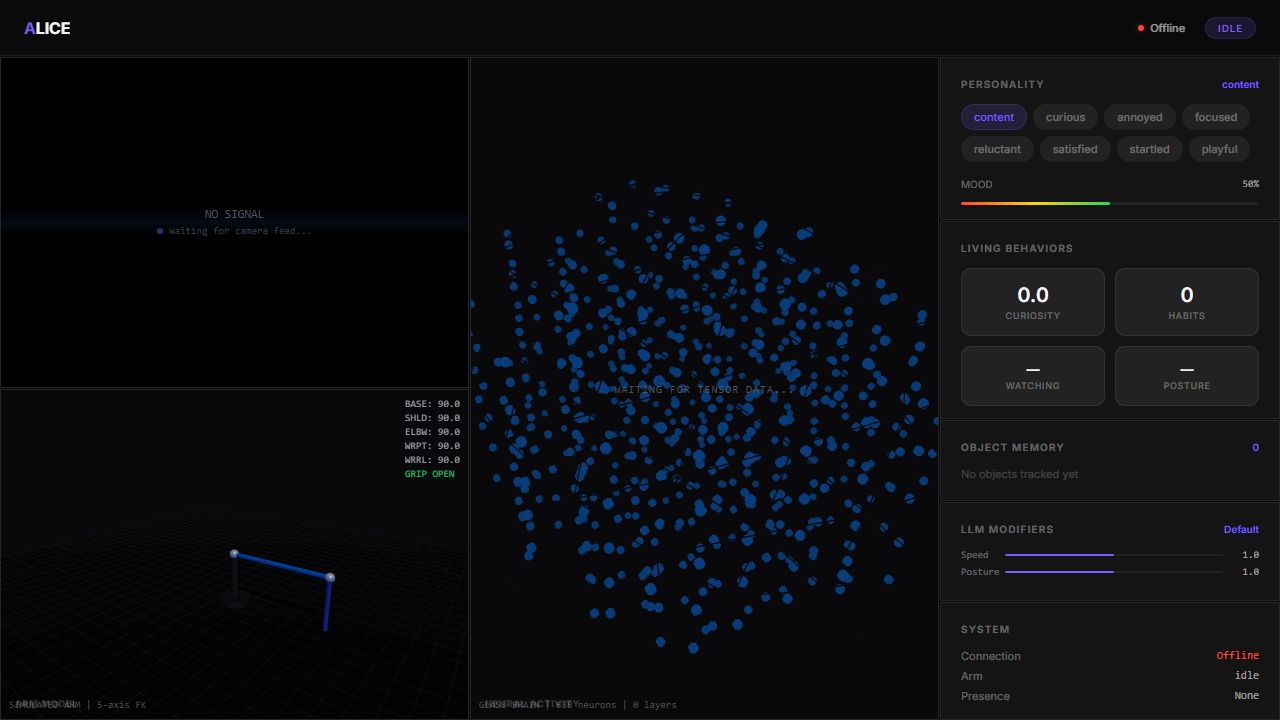
A plausible instruction is not necessarily an executable movement. The control boundary has to deal with malformed model output, missing hardware, and uncertain perception. An offline dashboard lets me inspect the interface independently of the physical system.
What exists now
The project includes the control software, an offline-capable dashboard, simulation tests, and documented failure handling. Software tests and interface captures are separate from physical demonstration evidence. The linked study documents those boundaries.
The next question
How can a robot communicate uncertainty before it acts? That question connects perception to the design of feedback, and to the Haptic Vision Array.