The Terrarium
An evolving population of trading strategies, with selection, mutation, and explicit risk controls.
“What happens when strategies compete, adapt, and try again?”
The question
I had considered building a trading bot for some time. Rather than assume I knew one best strategy, I wanted to explore how a population could respond to a noisy market with sophisticated competitors.
The system
Each software organism has a strategy family, adjustable parameters, capital allocation, and a performance history. Five starting families cover long-term growth, opportunistic trading, trend following, hybrid signal aggregation, and fundamental data. Evolution is the organizing analogy for selection, mutation, and replacement.
Where forecasting fits
A wrapper supplies historical closing prices to Google Research’s TimesFM and interprets forecast direction for trend and hybrid strategies. Forecasts are cached. If the model cannot load, the system returns an unavailable, neutral result. Integration alone does not prove that any particular run used the model.
The complications
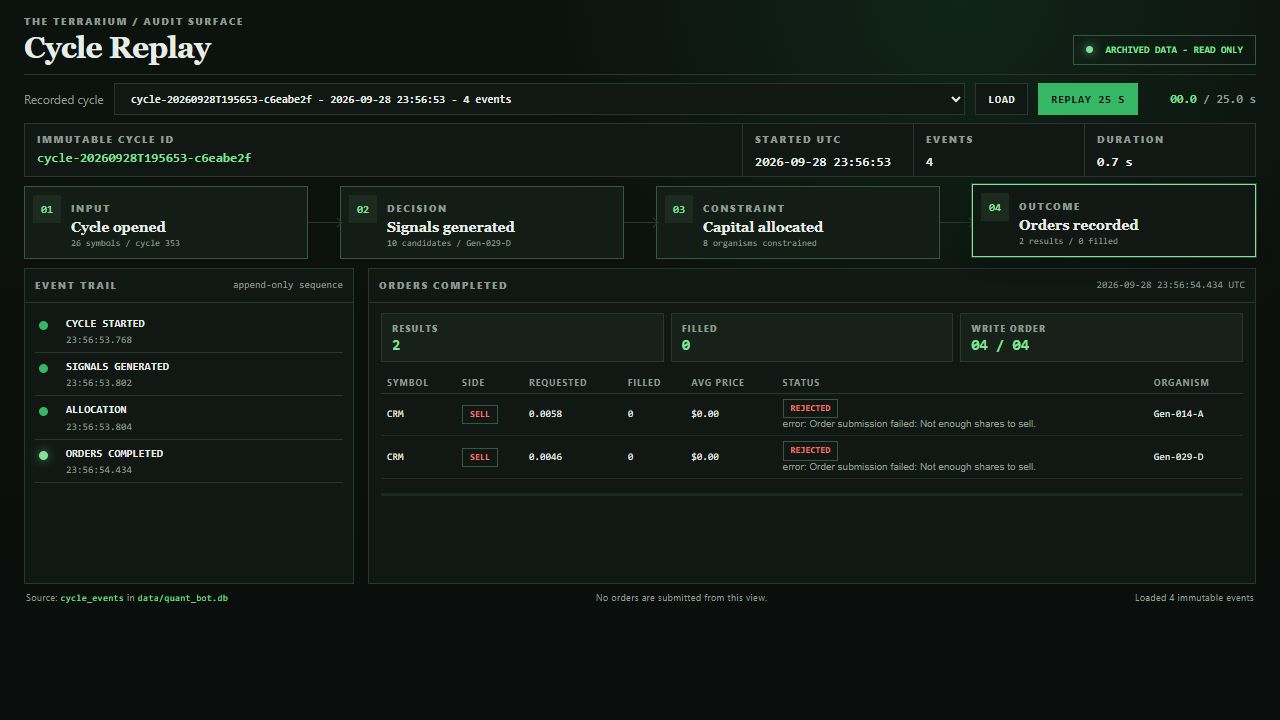
Recorded outcomes, broker execution, and a local replay are different things. Risk controls and transaction reconciliation matter as much as the signal. The study follows the Robinhood execution boundary and documents failures without treating a simulation as proof of live performance.
The next question
Does adaptation improve decisions, or just fit yesterday’s noise? Comparing evolving strategies against stable baselines is a question shared with forecasting and model verification.